PPN.fi
PPN.fi
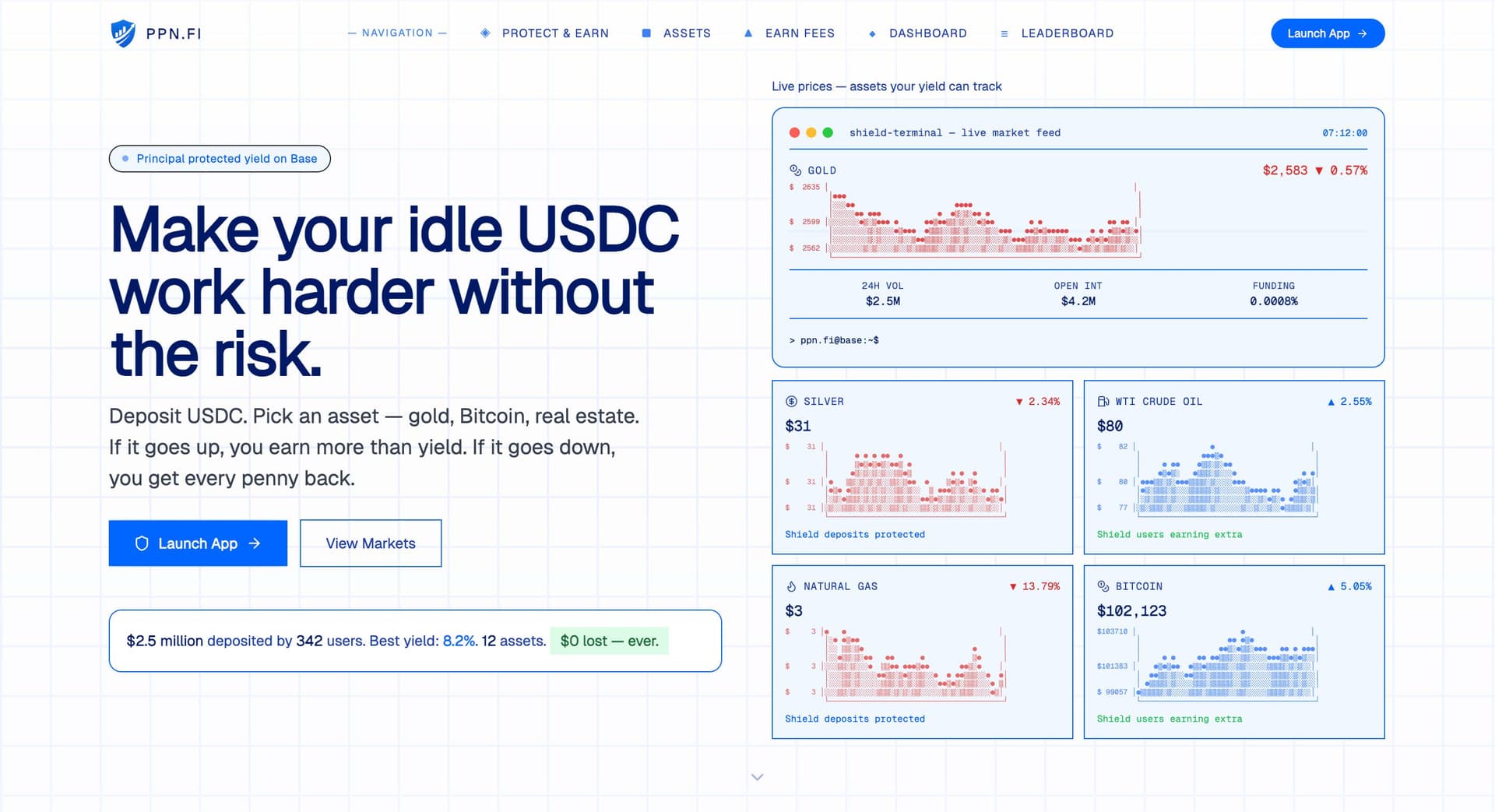
Deposit USDC. Pick any asset. If it goes up, you win. If it goes down, you get every dollar back.
Winner of ETHMumbai 2026, taking Best DeFi Project Overall, the Base (Coinbase) first prize for New DeFi RWA Primitives, and the ENS Pool Prize. Built on Base. Live at ppnfi.xyz, and written up on Devfolio.
It started with a question about fear
The idea did not begin with structured products. It began with hedging.
We were thinking about how producers and consumers sit on opposite sides of the same fear. A farmer who grows wheat is terrified the price will fall before harvest, so he shorts it. A bakery that buys wheat is terrified the price will rise, so it goes long. Neither of them is speculating. Both of them are buying certainty. That is what a hedge really is, and it is the oldest and most useful thing derivatives have ever done.
Then we looked at inflation, and the same shape appeared at a much larger scale. Everyone who holds cash is short an asset they never chose to short. Your savings account is a permanent bet that nothing will get more expensive. In 2025 that bet lost badly. Gold ran up 30 percent. Miami real estate climbed 12 percent. Bitcoin doubled. A savings account paid 3 to 4 percent. The saver did not lose money in nominal terms, but they lost anyway, quietly, the way you lose a race by standing still.
So the obvious answer is to let them hedge. Let ordinary people take long exposure to the things that are getting more expensive. But the moment you say that out loud, you hit the wall that has always stopped this from working. Taking exposure means risking principal. The person who most needs protection from inflation is exactly the person who cannot afford a drawdown. They have rent, school fees, a family. They cannot wake up to a liquidation. So they do the rational thing and stay in cash, and lose slowly instead of quickly.
That is where the second idea arrived, and it changed everything.
The thing banks have been quietly selling for forty years
There is a product that solves this precisely. It is called a Principal-Protected Note.
The structure is old and boring and completely proven. A bank takes your deposit and splits it in two. Most of it goes into a zero-coupon bond sized so that it grows back to exactly your original deposit by maturity. The small remainder buys an option on something interesting. If the asset rises, you keep the gains. If it collapses, the option expires worthless, the bond matures at par, and you walk away with exactly what you put in.
Goldman Sachs sells these. JPMorgan sells these. It is a multi-trillion dollar business, and it has been running quietly for decades. Minimum ticket size is typically 100,000 to a million dollars. Fees run 2 to 5 percent. Distribution is private banking. If you are wealthy enough to have a relationship manager, you already know about this. If you are not, you have probably never heard the phrase.
And here is the part that stopped us cold. DeFi has every single ingredient for this and nobody had assembled them.
The zero-coupon bond leg is just a yield vault. Morpho, Aave V3, and Moonwell on Base will all take your USDC and pay you a known rate. The upside leg is a perpetual futures position. Fully on-chain, permissionless, no options desk required. The math connecting the two is a formula that fits on one line and has been in finance textbooks since before most of us were born.
Traditional finance had been doing this for forty years. DeFi had all the parts sitting on the shelf. Nobody had put them together. So we did.
How it actually works
You deposit 10,000 USDC and choose an asset and a duration.
The protocol runs the present value formula, PV = FV / (1 + r)^t, and routes roughly 9,753 USDC into a Morpho, Aave, or Moonwell vault. That number is not a guess. It is the exact amount that compounds back to 10,000 USDC on your maturity date at the vault's current rate.
The remaining 247 USDC is your exposure budget. It is yield you have not earned yet, released early and put to work. It becomes margin for a leveraged position on whatever you picked: gold, silver, crude, Bitcoin, Solana, or the price per square foot of Charlotte real estate.
At maturity the vault returns your full 10,000. The position returns profit if the asset moved your way, or zero if it got liquidated. You receive 10,000 plus whatever the position made. Never less than 10,000.
The worst outcome is that you get your deposit back and gave up the yield. The best outcome is your deposit plus leveraged gains on an asset you believed in. There is no scenario where the principal is at risk, because the principal was never the thing being risked.
We ran 12.5 million simulations to make sure
A claim like "you cannot lose your principal" is either true in every case or it is marketing. So we tested it in every case.
The backtest engine runs the identical math the smart contracts execute, against real historical prices, for every possible entry date, on every asset, at every leverage level, across every duration. Not Monte Carlo. Not sampling. Every single one.
The price data comes from three independent sources. Gold and silver are COMEX futures closes from Yahoo Finance, 4,072 trading days running from January 2010 through March 2026. Bitcoin, Ethereum, Solana, and XRP come from CoinGecko Pro, going back as far as April 2013. The 19 US real estate markets are daily dollar-per-square-foot index values from Parcl Labs covering March 2021 to March 2026. That is 58,196 real daily price points across 25 assets.
The yield rates are not hardcoded either. Every run pulls live APYs from DeFiLlama for Aave V3, Morpho Steakhouse, and Moonwell on Base, so the results reflect what the protocols actually pay today rather than a number that flattered us.
12,523,401 simulations across 5,775 configurations. Principal protection: 100.0000 percent. Not one simulation, out of twelve and a half million, returned less than the deposit.
What the data actually said
This is the part that surprised us, because the results did not land where we expected.
Every row below is a real configuration from the backtest, running on today's live Morpho Steakhouse rate. Annualized return, liquidation rate, and the leverage and duration that produced it.
Crypto
| Asset | Best safe config | Annualized | Liquidation |
|---|---|---|---|
| Solana | 1x, 365d | +44.6% | 0.0% |
| XRP | 1x, 365d | +28.8% | 0.0% |
| Ethereum | 1x, 365d | +23.1% | 0.0% |
| Bitcoin | 2x, 270d | +10.4% | 19.9% |
Solana was the outlier nobody predicted. At 1x leverage over a year, no leverage at all, it returned 44.6 percent annualized without a single liquidation. The asset's own trend did the entire job and the exposure budget was enough to capture it. XRP and Ethereum told the same story. The lesson was uncomfortable and useful: in a bull trend, leverage was the enemy, not the engine. Bitcoin was the tightest pass, needing 2x over 270 days to clear 10 percent, because its lower volatility relative to altcoins means the exposure budget alone does not move the needle.
Commodities
| Asset | Config | Annualized (live yields) | Annualized (15% yield) | Liquidation |
|---|---|---|---|---|
| Gold (XAU) | 5x, 365d | +5.8% | +21.4% | 9.9% |
| Silver (XAG) | 3x, 365d | +4.6% | n/a | 13.6% |
Gold was the best risk-adjusted asset in the entire set. Sixteen years of COMEX data, from 1,117 dollars an ounce in 2010 to 5,061 today, a 352.9 percent total move. At 5x over a full year it liquidates less than one time in ten. Gold does not spike, it grinds, and grinding is exactly what a leveraged position wants.
Real estate, where the thesis actually lives
Five years of Parcl Labs data across 19 US cities. The spread was enormous, and the losers matter as much as the winners because they are what proves the protection holds.
| Market | 5yr return | CAGR | Volatility | Sharpe |
|---|---|---|---|---|
| Miami | +56.07% | 9.31% | 2.62% | 0.83 |
| Tampa | +46.72% | 7.97% | 2.42% | 0.55 |
| Charlotte | +36.57% | 6.43% | 2.01% | 0.16 |
| Las Vegas | +35.61% | 6.28% | 1.11% | 0.19 |
| Nashville | +34.45% | 6.10% | 1.76% | 0.06 |
| Washington DC | -15.92% | -3.41% | 2.38% | -2.68 |
| Austin | -26.44% | -5.96% | 7.31% | -1.09 |
Real estate indexes average 2.79 percent annualized volatility. Crypto runs 50 to 80 percent. Same leverage, same math, wildly different survival rates. That gap is the entire product.
| Market | Leverage | Duration | Annualized | Liquidation |
|---|---|---|---|---|
| Charlotte | 15x | 365d | +6.5% | 10.2% |
| Tampa | 15x | 365d | +6.5% | 10.2% |
| Miami | 10x | 365d | +6.3% | 8.6% |
| San Diego | 15x | 365d | +5.8% | 10.2% |
| Nashville | 15x | 365d | +5.8% | 9.2% |
| Miami Beach | 10x | 365d | +5.3% | 4.7% |
| Las Vegas | 20x | 365d | +7.2% | 17.0% |
Read the Charlotte row again. Fifteen times leverage, and only one position in ten got liquidated. Miami Beach at 10x liquidated less than one time in twenty. And every liquidated position still returned the full deposit.
Run the same markets against a healthier yield environment and the numbers get loud:
| Market | Leverage | Avg return | Best trade |
|---|---|---|---|
| Las Vegas | 100x | +82.79% | +416.29% |
| US National | 100x | +55.51% | +283.68% |
| Charlotte | 50x | +41.41% | +170.46% |
| Miami | 20x | +30.88% | +137.62% |
| Tampa | 20x | +26.09% | +82.87% |
That is the finding that reframed the whole product. Crypto is where PPNs look exciting. Real estate is where they actually work. You can run 15x on a housing index and sleep, because housing does not gap 20 percent overnight. Nobody has been able to take a leveraged position on Charlotte real estate before, because there was no way to price it on-chain. Parcl Labs solved the oracle problem, and that unlocked the largest asset class on earth.
The question that made the whole thing click
At ETHMumbai, the Coinbase team came by our table and asked the question we had been quietly avoiding.
Who is the liquidity provider?
It is the right question and it is brutal, because a PPN is structurally a long. Everybody who buys one wants an asset to go up. If every user on your platform is long Miami real estate, somebody has to be short Miami real estate, and that somebody is your vault. You have just built a machine that concentrates one-directional risk onto your own LPs and calls it a product. "Mercenary yield farmers will show up" is not an answer. It is a hope.
So we stopped building and went to study how the people who solved this actually solved it. We read through GMX and how its GLP pool absorbs trader PnL. We looked at Hyperliquid and its HLP vault. We went through Avantis and how it structures LP tranches for synthetics. Every one of them lands on the same uncomfortable truth: a pool that is the passive counterparty to directional traders only works when the flow is roughly two-sided, or when the pool is paid enough in fees to survive being wrong. In crypto, flow is genuinely two-sided, because for every person who thinks Bitcoin goes up there is someone who thinks it goes down. That is why their model holds.
Real estate is not like that. Almost nobody wakes up wanting to short Charlotte housing. We sat with that for a long time, and then it turned over.
We had opened this whole project with the wheat farmer. The producer shorts because he is scared of prices falling. The consumer longs because he is scared of prices rising. Both are hedging, and together they make a market that needs no speculator at all.
So what is the producer in real estate?
The developer. A developer breaks ground on a tower in Charlotte and it takes two years to deliver. His costs are locked in today. His revenue arrives in 2028 at a price nobody can know. If the market softens 15 percent during construction, his margin is gone, and there has never been an instrument that lets him do anything about it. He is structurally, permanently, painfully short-exposed to the exact index our users want to be long. He does not want upside. He wants certainty, the same way the farmer wants certainty. He will happily give up the gain above his underwriting to guarantee he does not eat the loss below it.
That is the counterparty. Not a mercenary. A hedger with a real balance sheet and a real reason to be there.
And it completes the model on both sides. The saver in Mumbai who cannot afford to lose principal takes the long, because inflation is eating her savings and she needs the exposure. The developer in Charlotte who cannot afford a price decline during construction takes the short, because his project is the collateral and he needs the protection. Neither one is speculating. Both are buying certainty from the other. The vault stops being a house taking the other side of every bet and becomes what a clearing venue is supposed to be: the thing that sits between two people who genuinely need each other, collects fees for standing there, and stays flat.
Passive LPs still deposit and still earn, but they are no longer the sole shock absorber for one-directional demand. They are earning fees on real two-sided flow. That is the difference between a vault that works for a quarter and one that works for a decade.
One question from the Coinbase table turned a product into a market.
The platform underneath
PPN.fi is not only the protected product. It is a full RWA perpetuals exchange with a liquidity vault, and the two feed each other.
The perp markets cover 19 US real estate city indexes through Parcl Labs, commodities including gold, silver, WTI crude and natural gas, the major crypto pairs, and forex including USD/INR. Go long, go short, up to 100x, with take profit, stop loss and real liquidation mechanics. PPN positions execute against these markets, and anyone can trade them directly.
The vault is the counterparty to all of it. LPs deposit USDC and earn base yield plus trading fees on every open and close, plus funding rates, plus the remaining margin from liquidated positions. Revenue splits 70 percent to LPs, 20 percent to treasury, and 10 percent to an insurance fund.
The real estate markets are the quiet advantage here too. Low volatility means the vault carries far less counterparty risk, positions stay open longer and keep paying funding instead of blowing up every week, and more users are willing to size up because the liquidation risk is genuinely low. It turns the vault into a steady fee machine rather than a casino float.
Conclusion
We set out to build a hedging tool and ended up rebuilding a private banking product for everyone else.
The structure was never the hard part. Principal-protected notes have existed for forty years, the math is a single line, and the banks have been running it profitably at enormous scale the entire time. The hard part was that the product was gated by minimum ticket sizes, relationship managers and 2 to 5 percent fees, which meant it reached the people who needed it least. Someone with a million dollars to deploy does not lose sleep over a drawdown. Someone with fifty thousand does.
DeFi already had every component. Yield vaults are zero-coupon bonds with better transparency. Perpetuals are options without the desk. Oracles like Parcl put the 45 trillion dollar US housing market on-chain for the first time. The pieces were all sitting there, permissionless, waiting for someone to connect them. That gap between what TradFi has quietly offered the wealthy for decades and what DeFi had never assembled is the entire reason PPN.fi exists.
And the question we could not answer at the start turned out to be the answer. We began with a farmer and a bakery hedging opposite fears, wandered off into structured products, and were dragged back to it by a single question from the Coinbase team about who provides liquidity. The saver is the consumer. The developer is the producer. One is scared prices go up, the other is scared prices go down, and neither of them is gambling. Put them on opposite sides of the same index and you do not have a yield farm, you have a market.
Twelve and a half million simulations, 25 assets, sixteen years of price history, and zero dollars of principal lost. The best configurations returned 44.6 percent annualized on Solana with no leverage and no liquidations, 21.4 percent on gold in a healthy yield environment, and double-digit leveraged exposure to Charlotte and Miami real estate with liquidation rates under 11 percent. And every one of those, including the ones that got liquidated, returned the deposit in full.
That combination is what took Best DeFi Project Overall at ETHMumbai 2026, the Base first prize for New DeFi RWA Primitives, and the ENS Pool Prize.
The saver who watched gold run 30 percent while their account paid 3 can now take that exposure without betting the thing they cannot afford to lose. That was the whole point.
What it did to me
I have to say something that is not about the product.
This project changed my mindset permanently. I went into that weekend thinking of finance as a category of app you build, a set of contracts and a frontend and some numbers moving around. I came out of it understanding that finance is really just a way of moving risk from someone who cannot carry it to someone who can, and that almost every good financial instrument ever invented is a version of that one idea. The farmer, the bakery, the developer, the saver in Mumbai. Once you see it, you cannot stop seeing it.
I did not expect to fall in love with zero-coupon bond pricing. I did not expect to spend a night reading about how structured notes are underwritten, or to care this much about the volatility profile of the Charlotte housing index. But somewhere in the middle of those 48 hours the whole field opened up for me, and it has not closed since. I read differently now. I look at products differently now.
Forty-eight hours, very little sleep, one question from a table visit that sent us back to first principles, and a way of thinking I will carry for the rest of my life. I will never forget that hackathon.
Built with data. Backed by math. Protected by design.